Nitrogen use efficiency measures the share of applied fertiliser that the crop actually takes up. On wheat, the apparent recovery coefficient of the first application ranges from 20 to 50%. The second application does better, between 40 and 50%. In practice, one unit in two never reaches the plant.
Three levels drive this result. The first is the dose and how it is split. The second covers application conditions: fertiliser form, moisture, incorporation. The third is the most overlooked — the biological condition of the soil, which determines what the crop will be able to capture.
Most articles on the subject deal with only one of these levels. This one takes them in order, from the most immediate to the most structural.
What is nitrogen use efficiency, and why does it plateau?
The apparent recovery coefficient, a simple benchmark
The apparent recovery coefficient (ARC) expresses the share of fertiliser nitrogen that the crop recovers in its biomass. An ARC of 40% means that one unit in 2.5 ends up in the plant.
This figure varies enormously from one field and one date to another. At the end of winter, a slow-growing plant makes poor use of its application: its root system is still short and its demand low. The first application therefore rarely pays off as well as the second.
The gap between 20 and 50% is where the real potential lies. That is where the savings are made, far more than in the choice of supplier.
Where the nitrogen that never reaches the plant goes
Three pathways account for most of the losses.
- Ammonia volatilisation. Nitrogen escapes into the air as a gas. The European Environment Agency uses emission factors of 19.9% for urea, 10.8% for nitrogen solution and 3.0% for ammonium nitrate. In the field, measured losses range from 0 to 15%, rising to 30% for urea in unfavourable conditions.
- Leaching. Water carries nitrates below the root zone. On average it affects 10 to 25% of applications.
- Microbial immobilisation. Micro-organisms tie up nitrogen to break down carbon-rich residues. This is the mechanism behind nitrogen hunger during the intercrop period — temporary storage rather than an outright loss.
These three pathways are not tackled in the same way. The first is decided on the day of spreading, the second over winter, the third over several years.
Why it becomes an economic issue for the 2027 season
The context has fundamentally changed. Tensions on energy markets have pushed up the prices of nitrogen fertilisers and fuel, to the point of threatening the profitability of French wheat. AGPB (the French wheat growers’ association) estimates cereal growers’ income at −€3,600 in 2026, the fourth consecutive year in the red.
Areas are following suit. According to Agreste, cereals are down 2.9% on 2025, at 8.54 million hectares, around 4% below the five-year average.
This context shifts the objective. Aiming for maximum yield assumed cheap nitrogen. Today, the trade-off is about gross margin, not the last quintal. A unit of nitrogen that does not get into the plant costs twice: once at purchase, then again in lost yield.
That is why efficiency deserves the same care as the dose itself.
Level one: adjusting the dose and splitting
Starting from soil residuals rather than habit
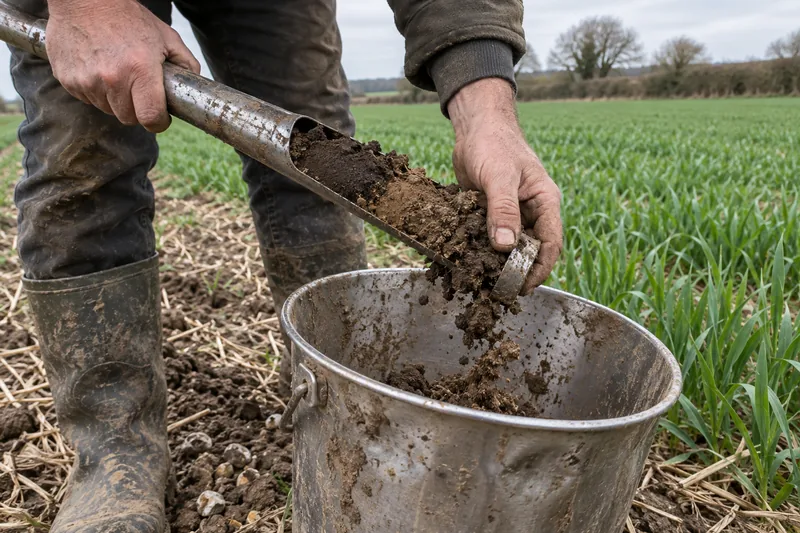
The right dose is calculated, not carried over. The nitrogen balance starts from what the soil supplies, set against the crop’s needs and the yield target. Without a residual nitrogen measurement, this balance rests on an assumption.
2026 makes this measurement even more useful. Drought blocked mineralisation over the summer, then the autumn rains restarted it abruptly. Residual levels are therefore very uneven from one field to another.
A practical tip: sample at least the two extremes of the farm — the field richest in organic matter and the driest one. The gap obtained can then be applied to the rest of the rotation.
Splitting to match the rate of uptake
Roots do not absorb nitrogen all at once. They take it up gradually as they explore the soil. A single large application therefore exposes a large quantity of nitrogen to losses, while the plant uses only a fraction of it.
Splitting synchronises supply and demand. It mechanically narrows the risk window. Terre-net lists several converging levers for the 2027 harvest: skipping the tillering application on soft wheat, tighter splitting, making use of livestock manures.
In-season monitoring completes the approach. It adjusts the last application to what the crop has actually built, particularly on wheat at stem elongation.
Diagnostic tools have become widely available. Chlorophyll meters, on-board sensors, satellite imagery: they all aim at the same thing — measuring nitrogen status before deciding. The last application is the one that can be managed best, because the crop has already expressed its potential.
Level two: securing application conditions
This level can be dealt with quickly, because the benchmarks are established and publicly available.
The fertiliser form weighs heavily on volatilisation. ARVALIS documents these differences precisely: over a rapeseed–wheat–barley rotation, the average efficiency of applications reaches around 79% with ammonium nitrate versus 75% with urea. The gap looks modest on paper. Applied to a fertiliser bill, it is not.
Three habits limit losses at spreading:
- Spread on moist soil or ahead of forecast rain. Water carries the nitrogen down into the profile.
- Incorporate urea when the cropping system allows it. On the surface, in warm and windy weather, it volatilises quickly.
- Make sure spreading is even. A badly set spreading width creates over-fertilised strips, where the surplus is lost to leaching.
These measures cost nothing but attention. They offer the best effort-to-result ratio on the list.
A word on the weather window. Warm, dry and windy weather after a surface application produces the highest losses. Conversely, 10 to 15 mm of rain in the following days secures the application. Postponing spreading by 48 hours costs less than losing a fifth of the dose.
Level three: getting the soil back into supplying condition
Mineralisation, a free supply we forget to count
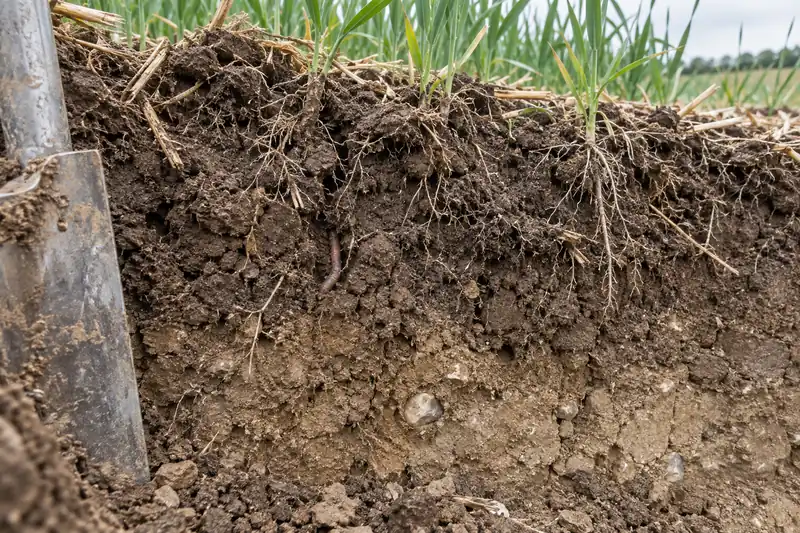
The soil produces nitrogen itself. Its organic matter mineralises every year at a rate of 2 to 6%, releasing nitrogen that is directly available to plants. This supply enters the balance just like a fertiliser application — except that it comes with no invoice.
Two neighbouring fields with different organic matter levels therefore do not have the same fertiliser requirement. As ARVALIS points out, making good use of organic matter inputs directly reduces dependence on mineral nitrogen.
A biologically active soil supplies more. A compacted, depleted or dried-out soil supplies less, and the farmer makes up the difference with fertiliser.
Microbial life and nutrient bioavailability
Mineralisation is not a chemical process. It is bacteria and fungi that convert organic nitrogen into an available form. Their activity depends on temperature, moisture and above all on the organic matter available.
Summer 2026 put this population under severe strain. With an average rainfall deficit of 40% and soils at their driest since 1959, biological activity slowed sharply.
This is one of the roles of plant growth-promoting micro-organisms (PGPM): restarting this recycling work and improving the bioavailability of nutrients already present in the soil.
Humic and fulvic substances: the role of the clay-humus complex
Humic and fulvic acids act on retention. They increase the soil’s cation exchange capacity, which holds nutrients instead of letting them wash away with water.
In practice, a soil with a well-developed clay-humus complex holds on to what it receives for longer. It buffers both losses and fluctuations in availability.
This also explains the agronomic value of organic matter from vermicomposting, which is rich in these humified fractions.
Helping the plant go and get the nitrogen
The last lever concerns the crop itself. A root that explores a larger volume of soil captures more, at the same dose.
This is precisely where biostimulants come in. As a reminder, a biostimulant is a product that stimulates the plant’s nutrition processes, independently of its own nutrient content. It acts on physiology, not on stock.
Three families of active ingredients are involved here:
- Phytohormones steer root development and rhizogenesis. A denser root system explores the soil horizon better.
- Amino acids support photosynthesis and the stress response, two conditions for active uptake.
- Polysaccharides improve tolerance to abiotic stress — those episodes when the plant stops taking up nutrients.
This last point deserves a closer look. During a heatwave or a water deficit, the plant closes its stomata and slows its metabolism. The nitrogen in the soil then goes unused, for lack of a crop able to take it up. Maintaining physiological activity during these windows therefore directly protects the investment in fertiliser.
This approach complements nutrient assimilation rather than replacing it. A biostimulant does not supply nitrogen. It helps the crop make the most of the nitrogen already there — whether applied or mineralised.
Results vary with soil, year and management. Thinking about this lever at field level remains essential.
Building the plan across the rotation
The three previous levels act over a single season. The rotation acts over five years.
Four decisions matter most:
- Introduce legumes. They fix atmospheric nitrogen and reduce the fertiliser needs of the following crop.
- Establish cover crops. They trap nitrates before winter, then release them to the next crop.
- Make use of manures and organic products. Manures, composts and digestates reduce dependence on purchased units.
- Raise the organic matter level. It is the slowest lever, and the only one that durably improves what the soil supplies.
INRAE points out that restoring balance in the nitrogen cycle means acting on flows, not just on doses. By combining these levers, a reduction of around one third in mineral inputs becomes achievable — gradually, and subject to field-level monitoring.
Frequently asked questions about nitrogen use efficiency
What percentage of applied nitrogen is actually taken up?
On wheat, 20 to 50% for the first application and 40 to 50% for the second. On average, then, around one unit in two. The rest volatilises, leaches or is temporarily immobilised in microbial biomass.
Can the nitrogen dose be reduced without losing yield?
Yes, provided efficiency makes up for it. Farmers who succeed combine three things: a dose based on measured residuals, tighter splitting, and a soil whose own supply has been improved. Cutting the dose without changing anything else costs yield.
Why is nitrogen lost between spreading and the plant?
Because it is constantly changing form. As ammonium, it can escape into the air. As nitrate, it moves with water. And soil micro-organisms capture part of it for their own metabolism. Each loss has its own window and its own lever.
Does a biostimulant replace a nitrogen fertiliser?
No. A biostimulant does not supply fertilising units — that is not its regulatory function. It acts on the plant’s ability to absorb and make use of the available nitrogen. The two approaches add up; they do not replace each other.
How long does it take for the soil to supply more?
Restored biological activity can be seen from the following season. Significantly raising the organic matter level, however, takes several years. It is a long-term investment, not a one-season fix.
Key takeaways
- One nitrogen unit in two does not reach the plant: the ARC of the first application on wheat ranges from 20 to 50%.
- Three sources of loss: ammonia volatilisation, leaching (10 to 25% of applications), microbial immobilisation.
- The dose is calculated from measured residuals, especially after a year as uneven as 2026.
- Splitting synchronises supply and demand and narrows the risk window.
- Fertiliser form and spreading conditions matter a lot: from 3% to almost 20% emissions depending on the form chosen.
- The soil supplies nitrogen for free by mineralising 2 to 6% of its organic matter each year.
- The biological lever is the slowest and the most lasting — and the one nobody sells with a fertiliser.
Improving nitrogen use efficiency means working on all three levels together. The first two can be corrected in one season. The third is built over time.
👉 To act on soil supply and nutrient bioavailability, discover our soil biostimulants. To support the plant during the growing season, explore our foliar biostimulants.
Sources (in French)
- ARVALIS — Nitrogen fertilisation of cereals: which form of nitrogen to choose in terms of technical efficiency?
- ARVALIS — Reducing dependence on nitrogen: making the most of organic matter inputs
- DRAAF Grand Est — Reducing nitrogen volatilisation
- INRAE — Nitrogen flows linked to livestock farming: reducing losses, restoring balance
- Terre-net — Nitrogen fertilisers: levers to reduce inputs in 2027
- Réussir Grandes Cultures — French wheat profitability threatened in 2026 by rising input prices
- Agreste — Field crops rapid information: 2026 areas